

Tomato plants and the Oregon coast are not easy friends. Our coastal region has so many challenges for tomato plants to overcome–cooler days and nights, a shorter growing season, less daytime heat to encourage ripening, summer mist and rain–sometimes it can feel like a huge effort to grow a tomato plant all for the thrill of harvesting a small handful of ripe tomatoes at the end of the season.
I’ve done a lot of trialing of varieties and growing practices to figure out what works for me, and for the customers I sell tomato plants to. One thing I know is that your location in our region will determine a lot about what you can grow. Is your garden a block from the ocean or ten miles inland? What side of the hill do you live on in Astoria? Which side of the highway do you live on in Gearhart or Seaside? Are you on the Long Beach peninsula in Washington State, or out in Elsie or Jewell? Do you have a greenhouse, or are you growing outside? All of these micro climates and situations will affect your ability to grow tomatoes successfully, and will determine which tomatoes are the right ones for your garden.
We first started selling tomato plant starts in 2004 at the Astoria Sunday Market from our first farm in Seaside, Ostman Farm. As I was still learning about growing on the north Oregon coast, I first grew a combination of tomatoes that I thought would do well here, varieties recommended as good for the PNW, and varieties people were asking for. I have trialed so many tomatoes over the years! Some varieties I love deeply, but just don’t grow any more because they need too much hand holding to produce, or there just isn’t a good market for them.
If you are growing outside-and most people here are-a good starting point for our region is to look for tomatoes that are either early or mid-season ripeners, 80 days or less to maturity. Then look at fruit size–smaller tomatoes are going to ripen more easily than big ones, and cherry tomatoes varieties tend to give the most success of all. This doesn’t help when what you really want is a big slicer to put on a sandwich or burger! There are larger sized tomatoes that will ripen here, at least in some parts of our region, so don’t loose heart.
When we moved to the property in Olney that has become 46 North Farm, tomatoes were one of the first crops I was eager to get growing again. We built a huge high tunnel greenhouse that allowed us to grow tons of tomatoes over the years, until an outbreak of powdery mildew in the greenhouse forced me to move my tomato production outside. This challenge came around the time where I had been trialing dry farmed tomatoes for the OSU Small Farms Dry Farming Collaborative for a few years, so I had a sense of what varieties worked outside and which ones didn’t, and I had also learned that–at least on my farm– tomatoes were much more adaptable, and needed way less irrigation here than I thought.

Some tomato terms to be familiar with are determinate and indeterminate. Determinate tomatoes will grow to a certain height and then generally stop. These could be very tiny varieties that only get 2 feet tall, or ones that get about 4-5 feet tall. Determinate varieties are often hybrids, as they have been bred to be easier to grow and harvest, but there are many open-pollinated determinate varieties as well. Indeterminate varieties can be hybrids, open-pollinated or heirlooms, and will grow as big as you let them, sometimes 8-10 feet or more. Often cherry tomatoes are indeterminate and can get very wild by the end of the season if you don’t prune them.
Other terms I just used are hybrid, open-pollinated, and heirloom. Hybrid tomatoes are varieties that have been bred by manually crossing two individual varieties to make a third unique variety. This is not genetic modification, this is a breeding practice that humans have been doing for a tremendously long time. The challenge here is that the seeds of the unique variety will not come true if you save them and plant them out again, they will sometimes look like one of the parent varieties, and sometimes like something totally different. One of the most popular hybrid varieties is the Sungold cherry tomato. Many, many plant breeders are attempting to de-hybridize the Sungold by growing out generations of plants looking for a stable version that will come true from seed. Hybridized varieties are very popular in the commercial farming world because plants are often bred for things like ripening all at once, or shelf-stability, or being able to pick the fruit when it is green and slowly ripen it to ensure it makes it to supermarkets thousands of miles away. Some hybrid varieties are wonderful, and some taste like nothing. The other downside to hybrids is that they are often owned by large multi-national seed corporations, and sometimes they are patented which means you need a license to grow them. I try to avoid hybrids where I can unless its the only option for a great variety.


Open-pollinated varieties are ones that you can save seed from, re-plant and know that you will get the same variety that you saved the seed from. All heirlooms are open-pollinated, but not all open-pollinated plants are heirlooms–you can breed open pollinated varieties as well, and stabilize them by growing them out for a number of years to be sure that the plants come true consistently. Heirloom is a complicated description for plant varieties that has no legal standing and as many definitions as you can imagine, much like ‘Artisan’, ‘Sustainable’ and ‘Authentic’. A general guideline is that a plant can be considered an ‘heirloom’ if it dates from pre-World War 2 industrial agriculture times. But I also see varieties bred in the 70s being called ‘heirloom’ including one of my favorite tomatoes, the Green Zebra, bred by Tom Wagner. Also, older tomato varieties tend to be longer season, and often prone to disease in our challenging coastal growing climate, so I tend to steer clear of them unless one really captures my heart. There is a big movement among plant breeders to breed and protect open-pollinated varieties to allow for greater genetic diversity in our crops, and to prevent plant patenting. I encourage you to look for seeds that are part of the Open Source Seed Initiative, as these are varieties where breeders have pledged them for open source breeding, meaning that they cannot be patented.
Another term you’ll see on seed sites is Days to Maturity. This is generally a good guideline for figuring out if this is a short or long season variety, and so whether or not it’s one you want to grow. (Remember, on the coast, shorter is better!) However, ‘Days to Maturity’ is an average number, usually starting from either planting a seed outside, or a transplant, and it depends of where the variety is being trialed as to how many days it might take for a crop to mature. Was it trialed in the PNW? On the coast, or inland? Was it trialed in the Midwest or on the East coast? All of those factors mean that for us, these numbers are good guides, but not an accurate prediction of how many actual days it will take for the fruit to ripen.
Here are a few planting tips that I’ve learned over the years to help encourage success. For planting tomatoes outside, it pays to wait until the weather–and the soil–warm up. Outdoor tomatoes can take a bit of rain and cooler weather as they establish, but I find planting them in mid to late May is the best window here. Early June is still ok, but much later than mid June and you likely won’t get many ripe tomatoes, unless you are growing an extra extra early variety.
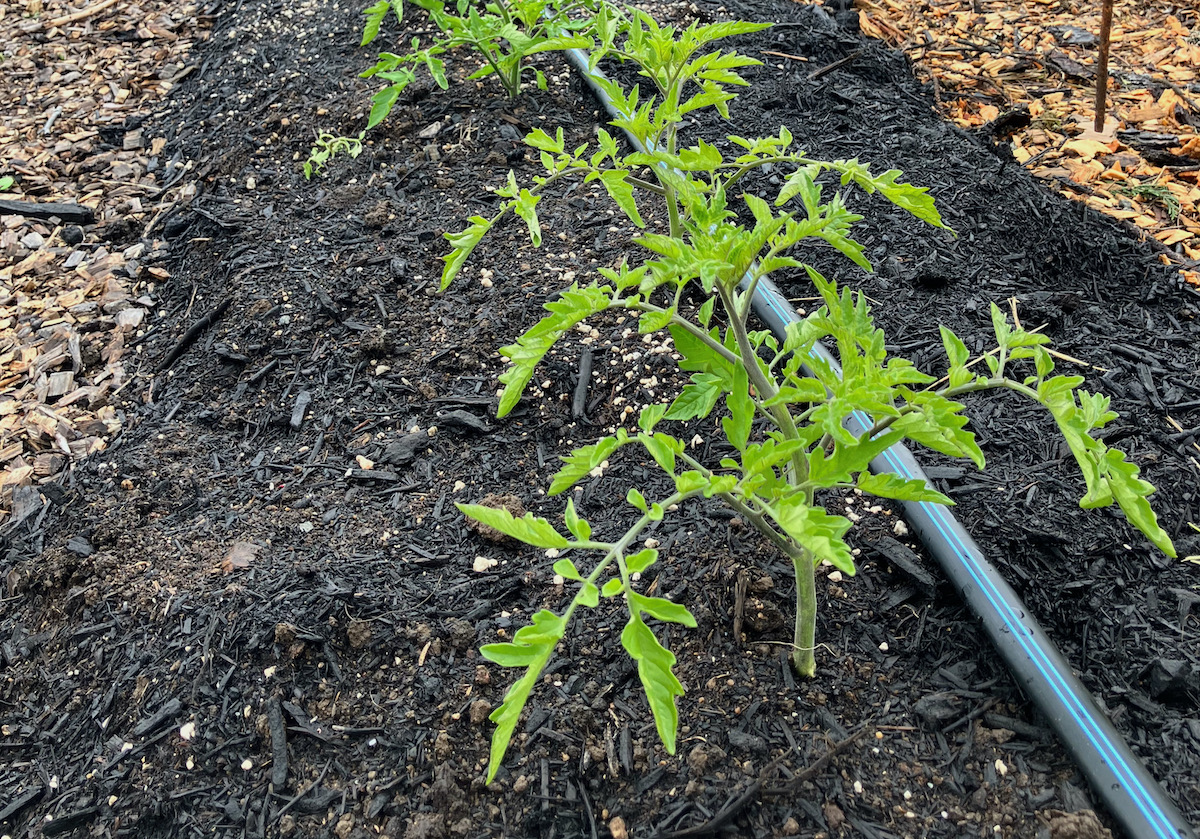
Try planting your tomatoes deep to encourage strong root development. If you pick off all the the lower leaves of the tomato plant and then plant it so that only the top bit of stem and leaves are above the soil, all the places where leaves were growing will send out roots instead. This can feel very weird to do, but trust me, it really works and your plants will soon start growing a nice strong stem. You want to amend your soil well with a good all-purpose organic fertilizer, and make sure you are planting it in soil that is well drained, as tomatoes don’t like wet, heavy soil. Full sun is non-negotiable, and full sun means 6-8 hours a day. Find the warmest spot you can, that’s where your tomatoes will thrive.
As important as a sunny location is the soil you are planting your tomatoes into. They do not like wet roots at all, so you need to pick a well-drained spot, and amend the area well with good compost and some good all-purpose organic fertilizer. If you haven’t applied lime to your soil in recent memory, consider starting to add a yearly application of lime, as most fruits and veg that folks want to grow here are not native to the Oregon coast, and our soils are much too acidic for them to thrive. If you want to be more exact about how much to apply, get a soil test done (Master Gardeners from OSU Extension can help with how to do this), which will give you an idea of where your soil pH is at.
For many folks, the best soil and location to plant their tomatoes in is going to be in a container. If this is your situation, it’s totally fine, many tomatoes will grow very well in containers. The size of your container is going to be very important here, as I think most gardeners tend to underestimate the size of container their tomato would prefer. Determinate tomatoes can get by in smaller containers, depending on how big the plants get. For tiny tomatoes, and hanging basket types, you can do those in maybe a 2 gallon/10 inch pot. If a tomato grows to 3 or 4 feet, a five gallon pot is the smallest size I would use for it. And for indeterminate tomatoes, the bigger the better–10-20 gallon size containers, or half barrels. And yes I mean that for one tomato, not several in one pot. This can be very daunting, as potting soil is expensive and sometimes space for larger containers is limited. You can grow tomatoes in smaller containers, but know that the plants themselves won’t get as large as they might otherwise, they are going to be more stressed and not produce as much, and you’re going to have to really pay attention to watering. If you can only grow in containers I’d advise sticking to determinate varieties, but also–you should just do what you want to do, give it a try and see how it works. That’s how we learn as gardeners! Sometimes you just have to give it a go.
Watering is one of the most contentious parts of growing tomatoes, and all I can say here is that it really depends on your soil as to how much you need to water them. If you are growing in containers, you’ll need to check them regularly, especially if it’s been sunny and hot, to see if they have dried out. Tomatoes don’t like to grow in bone dry soil, but they also don’t like soggy, saturated soil. You can definitely over water them. If you live near the ocean and your soil is sandy, you’ll likely need to water more regularly. If you live more inland and your soil is clay based, water less frequently. I never recommend watering on a schedule, like ‘once a week’ or ‘every other day’ because it depends. How warm has it been? How windy? When was the last time it rained? How much moisture is actually in the soil a foot or so down? Try to do more than just stick your finger in the top inch or of soil and see if it’s dry. Tomato roots go deep–that’s why we can dry farm them–and they are able to find moisture deep in the ground if its there. Moisture sensors aren’t super accurate, but they can help give you an idea of how moist your soil is a foot or so down. Take several readings, and if moisture levels are about halfway or less you can go ahead and water. Anything more than halfway and I’d wait a bit. For in-ground tomatoes, I’d also advise to either greatly reduce or cut off water altogether later in the season, unless you are growing in very well drained, sandy soil. Stressing your plants in this way can help encourage ripening, and helps to lessen splitting if we do get some late summer rainfall.
Tomatoes do need support, even determinate ones! Sometimes the very tiny cherry tomatoes can be left unsupported, or grown as a hanging basket type thing, but for everything else, you’re going to need to support it. Tomato cages can work for determinate varieties, but often even those will outgrow a cage. I like to trellis my tomatoes as it allows for easier pinching and pruning, and I think allows for better air flow around the tomatoes. Our indeterminate tomatoes are pruned to two main stems and then trellised up strong strings coming from a overhead support pole, and our determinate tomatoes are trellised using a system known as the Florida, or Basket Weave. You can find a lot of videos on line for how to do the Florida/Basket Weave, and I encourage you to look them up, it’s a really good system. Or, you can use any kind of open trellis and tie your plant to it as it grows-whatever works for you is what works best, or use cages if you prefer. Again, what works best for you works best for you!


An important maintenance tip is to pinch out suckers where you can. Suckers are the new stems that grow in the crotch of the plant between the stem and the leaf. If left to grow out they will turn into another branch bearing flowers and fruit, and letting them all go can make for a crazy crowded plant with not enough air flow to allow all the fruit to ripen. It’s easiest to pinch the suckers out when they are small. It they grow to much larger than a pencil diameter it’s best to use snips to cut them out so that you don’t accidentally break the main stem of the plant. Try to cut as flush to the stem as you can, and not leave a stub of the sucker there, as that can sometimes be a place where disease can set in.
There are a million more words that can be written about growing tomatoes, and they likely already have been. You can find books, videos, blog posts, podcasts and more that will cover how people should grow tomatoes, and as many conflicting opinions as there are media pieces. What I’ve written here is what I’ve found works in general for my farm, and for the growers and gardeners I know in our very specific north Oregon coast climate. If you are reading this from some other part of the state, the country, or the world, then I would advise you to reach out to gardeners and farmers in your area and see what growing practices work best for them, and what tomato varieties they recommend.
Below is a list of tomatoes that I consistently grow now, outside on our farm in Olney. We’re about nine miles from Astoria, and definitely warmer in the summer months than more coastal locations like Seaside or Cannon Beach. But we do still get fog, rain, cool nights and the same day length as everyone else here. These varieties always produce a good crop for us. Some years are better than others, always, but they are the varieties I trust. This does not in any way mean these are the only varieties that will grow well here! I’ll list some other favorites and solid producers that I don’t grow much anymore but which I know have a great following among coastal gardeners.
I’m not growing all of these varieties this year, but the ones described are ones that I am confident will do well for me year after year. I wish you good luck with your tomato growing adventure, as in my opinion there are few things more delicious than a vine-ripened tomato eaten when still warm from the sun, and I hope that everyone gets to experience that at least once in their life (but preferably every year).


CHERRY TOMATOES
Sungold
57 Day Extra Early season Hybrid Indeterminate
Sungold is the one hybrid I’ll consistently keep growing, because it really does taste amazing, and because its extra-early fruit set means we reliably get lots of ripe tomatoes from it here on the coast. I’ll keep trying out de-hybridized versions, but for now this is still a farm favorite.
Sweetie
65 days Early season Open-pollinated Indeterminate
A classic red cherry tomato, and one that does well for us here on the Oregon coast. Fruits are about 1-1/2″ and firm (but not tough). Great cherry tomato flavor, productive and reliable. I love a reliable tomato!
Peacevine Cherry
78 days Mid season Open-pollinated Indeterminate
Peacevine Cherry was bred by the late Alan Kapuler of Peace Seeds in Oregon. Abundant 1″ fruits have currant tomatoes in their lineage so are full of sweet-tart flavor and produce lovely clusters of fruits to enjoy. It’s a later ripener which I usually avoid, but it’s worth the wait as when it kicks in, it’s wonderful.
Flaming Burst
70 days Mid season Open-pollinated Semi-determinate
I’ve grown a lot of yellow pear tomatoes over the years, and I really like them. Flaming Burst isn’t a traditional yellow pear, but it’s fast become my favorite one to grow. Bred by Tom Wagner with some Jaune Flamme in it’s parentage (another of my favorite tomatoes), the fruits are a more golden orange than straight yellow, plants only grow to about 4-5′ tall, and produce huge trusses of fruits that are so delicious. Yellow tomatoes tend to be lower in acid than red ones, so this is a good tomato to grow if you aren’t fond of tomato acidity.
Koralik
65 Days Early Season Open-pollinated Very determinate Great for containers
I don’t grow Koralik every year, as it’s more of a container variety and not one I grow out in our farm beds. But I keep growing it because I really like it, and I love to share it with our customers. It’s such a great tomato for gardeners with smaller gardens or only containers to grow in, small enough to grow as a hanging basket tomato if you want to. Plants only get about 3′ high, so do need a bit of support (a small cage is great here), and are loaded with small 3/4-1″ sized red fruits that are so tasty. Originally from Russia, this variety has found many fans all around the US for it’s versatility, manageable size, early ripening and great flavor.
Other cherry tomato varieties I’ve grown successfully and really like: Washington Cherry, Black Cherry, Pink Bumblebee, Super Sweet 100, Gold Nugget


SMALL TO MEDIUM TOMATOES
Stupice
60-65 days Early season Open-pollinated Indeterminate
Stupice was the first new-to-me variety I grew in Oregon back in 2004, recommended by Seattle Tilth as a good variety of the Pacific Northwest. I’ve grown it every year since, and it has never let me down. Bred in in the mid-50s at an ag station near the town of Stupice in the Czech Republic, it was introduced to the US in the 1970s by the Abundant Life Seed Foundation, and has found a very loyal fan base, especially in the PNW. Small to medium sized tomatoes are as sometimes called ‘salad’ or ‘saladette’, as they are nice in salads? They are also big enough to slice and put on a sandwich if you need that ripe tomato flavor there. For us, this is often the first tomato to ripen, and the last one to be done in the fall. And, I’m told, the proper pronunciation is Stu-peach-kah.
Glacier
55 days Extra early season Open-pollinated Determinate
I’m not sure why Glacier doesn’t have more of a following in the PNW, because it is one of my favotire tomatoes, a solid, reliable producer of ripe red flavorful tomatoes all summer long here. Maybe it’s just not sexy enough, but it’s plenty appealing to me. This is the workhorse tomato on our farm, the one I grow the most of and fill flats and flats with, make our tomato jam with, make sauce with, make my favorite Greek salad with, use for everything. I’ve been trialing growing it under dry farmed conditions (no irrigation) and it’s showing a lot of potential for me. Plants only grow about 4′ tall, so it can be grown in a container if you need to. It will need support, so give it a trellis or a cage to keep it upright. It’s good to pinch the suckers out or else it can get crazy.
Jaune Flamme
70-80 days Mid season Open-pollinated Indeterminate
I’m not sure when this tomato moved from France to the US, but I’m very glad it did. Another mid-season variety that I find well worth growing, Jaune Flamme produces lovely medium sized deep orange tomatoes that are so beautiful and full of flavor. They look like a huge Sungold tomato, and have a similar sweet tart gorgeousness about them. Colorful tomatoes are often longer season ones that are harder to grow here, but this one is a keeper for me. Indeterminate, so the vines will definitely need support.
Other small to medium sized tomatoes I’ve grown and loved: Green Zebra, Black Prince, Early Willamette


ROMA/PLUM TOMATOES
Roma, or Plum tomatoes are usually grown for making sauce or for drying. Many folks find that their flavor improves when they are cooked or dried, and that their fresh flavor is a bit middling. I’ll still eat them fresh, and a vine-ripened plum tomato is still going to taste better than a harvested-green-and-gassed-to-turn-red supermarket tomato anyday. But just know that their purpose if more for cooking, not fresh eating.
Principe Borghese
70 days Mid season Open-pollinated Indeterminate
I don’t remember when I met Principe Borghese, but I’ve loved it for years. It grows really well for me here, and although you often see it described as determinate, I find that it can get huge, and pretty rampant so pinching out suckers is a good idea. It produces nice big trusses of little red plum tomatoes that are just lovely. I’ve dried them with great success (in a dehydrator, not in the sun as they do in Italy), and they make fantastic ‘sun-dried’ tomatoes. I use them in sauce both fresh and frozen. And yes, if I need some tomatoes for a fresh salad and all I’ve got are PBs then I’ll chop ’em up, and they are delicious.
Fiaschetto di Manduria
65-70 days Early-mid season Open-pollinated Determinate
I don’t grow a lot of plum tomatoes as there isn’t a huge market for them either as plant starts or fresh. Well, there are a lot of folks looking for canning tomatoes in late summer, but they want huge flats of cheap tomatoes, and that’s not what we do here at 46 North Farm. So I grow a few plants for us, and Fiaschetto is one that I keep coming back to. I like that it’s determinate, so I can mix it in with my row of Glaciers and they will grow to about the same size. The are bigger than a Principe Borghese, and have good flavor for a plum tomato. For a mid-season tomato I find that I get a lot of ripe fruit, which is always promising. I don’t grow it every year, but when I do I’m always happy I did.
Other Roma/Plum tomatoes I’ve grown successfully in the past: Black Plum, Striped Roman, Annarita, Grappoli d’Inverno, Thai Pink Egg


LARGE TOMATOES
Aurora
60 days Early season Open-pollinated Determinate
I first trialed Aurora about six years ago, and didn’t really believe that it would ripen outside for me, as these larger tomatoes rarely do ripen outside of a greenhouse. I found it at Adaptive Seeds, to whom it was recommended by the Real Seed Catalog in Wales. I figure that if a tomato will grow well in Wales, it has promise for the Oregon coast, and I’ve had that confirmed each year I grow it–it’s now the only larger sized tomato I grow. The main problem I have with Aurora is that its too productive, and the heavy tomatoes can weigh down the branches so much they can snap, so pinching and pruning this one is essential. Aurora reliably ripens for me (and for many plant start customers!) grown outside here, and it has a wonderful tomatoey flavor. It’s big enough for that ‘one big tomato slice on a burger’ use, is lovely in salads, cooks well and is just an all-around fabulous large tomato for coastal growers. Forget trying to get that Big Beef to ripen, Aurora has got you covered.
Other large tomatoes I’ve grown successfully in the past: Siletz, Santiam, Spring King, Paul Robeson (this one really does best in a greenhouse, but I have to mention it because the flavor is amazing)
