

Lately there has been a trend on social media for people to post photos of themselves from a decade ago, the year 2016. And while I’m not much for participating in ‘post a photo from x specific situation!’ trends, it has gotten me thinking about 2016. The photo above might seem to you like any other photo of a growing zucchini plant, but for me this photo from 2016 represents the beginning of a whole new era of my farming career, where some of the best parts of farming, and some of the best parts of myself, began. It was also one of the hardest years of my life.
In retrospect, 2016 was transformative both culturally and politically, not just in America but around the world. Terrorist actions and war escalations happened in too many places. North Korea conducted nuclear tests. There was a mass shooting at the Pulse nightclub in Florida. Colin Kaepernick refused to stand for the national anthem, sparking racial reckonings still going on today. There was a failed coup in Turkey that set democracy back there to this day. The now sadly ironic moment that the US and China both signed the Paris Climate Accord happened. More irony: measles was declared eradicated in America in 2016, and I’m in the midst of getting a booster vaccine because it’s back in 2026. The UK voted for Brexit, the Philippines voted for Rodrigo Duterte (fortunately now being held in the Hague on charges of crimes against humanity) and America voted for Trump for the first time. (Future Hague trip uncertain.) It was peak Hamilton on Broadway, and Prince, George Michael and David Bowie all died. 2016 felt like a turning point, and also a breaking point. It’s hard to be fully aware of the significance of something when it is happening, but thinking about it from a decade’s distance, 2016 really was one of those years.
On a personal level, it was the first year I worked solely for the farm and didn’t have an off-farm job during the growing season. The year that one of my knees buckled in a painful jolt in early July, rendering me unable to walk without a crutch or knee brace for months, which is a huge challenge for a job as physical as farming. Months of expensive adventures in America’s ridiculous medical system finally led to a diagnosis of osteo-arthritis–not nearly as bad as I’d feared, but something that required a lot of physical therapy to heal, and meant I had to make long-term, permanent changes to how I worked as a farmer.
Early July of 2016 was also when my father passed away. He was in an assisted living home near my sister Ann in Maryland, and in the frantic rush to catch a flight to hopefully be with him before he died (I made it with a few hours to spare), I had to let go of the fierce control that I had worked under for years and trust in the friends stepping up to help Packy take care of the farm while I was gone. The farm survived just fine without me, which was both humbling and liberating.

I experienced how a community can rally around and help support you during a crisis, as friends continued to help after I got back to the farm but was still injured and unable to work at full speed. They stepped up to help harvest, wash and pack produce, and help out at the farmer’s market when I couldn’t stand for very long at a time. They were there for me when grief made it hard to smile for customers and chat about produce and flowers while inside I was reeling and adjusting to having no living parents. My mom passed away in 2001 at the age of 75 (emphysema, please don’t smoke, it doesn’t end well) and her death in many ways was the life crisis that prompted me at the age of 35 to jump off the cliff, convince Packy to move to the Oregon coast with me in 2003 and start a farm, and then just…start farming. “Life is short”, I kept telling myself. “What if you only have forty years left? Do it now”. And somehow, we did.

“We moved to the Oregon coast and started a farm” is a sentence that hides an awful lot. The learning curve was fierce, the challenges enormous, the failure to success ratio was daunting. My dad was an enormous help to us in that first decade, both financially and emotionally. I think for both he and I, starting the farm was something to dive into and focus on that helped deal with the grief of loosing my mom, his wife, and the resulting unraveling of our family structure.

He listened to me talk about farming and my plans for the farm for hours, offered advice and perspective, and loved to come stay with us for at least a month each year during the summer. He wasn’t a manual laborer, and was in declining health even then, but he enjoyed coming to farmer’s markets with us, and doing simple jobs like de-budding dried lavender, or shaking seeds out of dried poppy pods, or helping bunch flowers to dry for the wreaths I’d make in the fall. He was great at putting together crock-pot meals for us so that when we all got home from Sunday Market in Astoria we had a hot meal waiting for us. He always encouraged us to keep learning, to keep going, to keep working towards a better future. He was staying with us in 2009 when we took the leap to buy the property where 46 North Farm lives now, and the financial help we got from him, and from Packy’s parents, was what made the deal possible for us. His support for this farming project was deep and strong, and the loss of him in 2016 was a blow to my sense of equilibrium both a his child, but also as the farmer I had become with his support.

2016 is also the year that I first officially attempted to dry farm crops. I had never planned to not fully irrigate everything we grew, but a quirk in the layout of the land on our farm meant that there were two separate areas that were appropriate for growing crops, with a big wetland area and a deep gully in between them. Although we knew that irrigating the lower field would be a challenge, it was the area that really captured us when we first looked at the property. Well, it captured me. Packy spent most of his time wandering through the old barn and out buildings, while I was sticking my hand down into mole hills and looking at the deep brown soil and thinking “wow”.
The lower farm was a mostly flat acre that looked ideal for siting a growing area. The only drawback–and it was a big one–was that there was no easy way to irrigate it. The property came with no water rights and only an old, out of use shallow well. Water for the house came through a community water system that tapped into the larger Astoria water district, and although water was abundant for the house and surrounding area where we planned to site two more fenced growing areas, the distance to the lower farm area was way too long for a hose to stretch.
We hadn’t worked with the National Resource Conservation Service (NRCS) on our first farm in Seaside because we didn’t own the land and couldn’t make decisions about long-term infrastructure, but when we moved to the farm in Olney we connected with our regional NRCS agent, and she spent time walking us through the various infrastructure projects that the NRCS could help us with. There were two things we knew we needed before any crops could be grown–an elk fence, and an irrigation system.

The NRCS is a division of the US Department of Agriculture. Some policies are federal, and some are state-based, or even regional. The main thing we got to know about the NRCS is that that they can’t help you start doing something that will threaten a natural resource (crop irrigation water usage, soil erosion, and so on) but if you are already doing things on your farm that impact natural resources, and doing them badly so that the resource is being harmed or wasted in some way, then theoretically they can step in and help you do it better. Something else that we quickly learned was that regional districts all set their own priorities and decide what services they will provide in their area, so even if an NRCS program in a different state–or even a different county in Oregon–will fund things like solar panels, or water-capture systems, or elk fencing, it doesn’t mean that your local program will fund those things. Some projects were not possible on a national level, and some not possible only in our area, and it wasn’t always clear which was which when one agent would start setting up a program for us and then leave, and the next agent would say it wasn’t possible, but this other thing was.

For example, our first NRCS agent found a way to get funding for us for elk fencing for the three main growing areas we had planned. We tilled the lower farm, sowed buckwheat and documented the results as the elk herd came in and destroyed it in a few days, justifying the need for elk fencing to protect the cover crop soil building we were doing. Then two things went wrong. First, our NRCS agent left for a new job, and the main office decided that they didn’t want to pay for the elk fencing as it was a type of project they didn’t want to fund in our area in the future, so they told us they were cancelling our contract for that. We told them that if that was the case there was no point in doing any of the other projects we had planned with them, because without elk fencing we couldn’t grow any crops. (As demonstrated by the Buckwheat vs. Elk experiment.) They reluctantly allowed the project to go forwards, but not without the second of our mistakes hitting us. We had labeled one of the three growing areas we had planned as an orchard, and they did strip out the funding for elk fencing for that area, reasoning that it would be a permanent planting and thus would not be growing cover crop and would not need protection from elk.

We tried planting fruit trees in this area starting in 2019 and individually caging them, but the elk just laughed at the cages, reaching over the top to tear off branches, strip leaves and bend the fencing over so that the deer can come in and finish off pruning the trees. The trees have never gotten taller than the cages, and we’ve never yet had a harvest from any of the them except for a handful of figs and a random apple. Fencing has only gotten more expensive over the years, and although I’ve tried several different sources of funding to help us build the fence, they all fell through. Finally, in 2026, with generous help from family (a thousand thanks, Laura and Bruce!!) we are building the fence around the orchard, and look forward not just to all our fruit trees healing and producing, but new plantings of blueberries and raspberries, rhubarb, grapes and more.

Our next NRCS agent was great but also sadly short lived in the job. She helped us to secure NRCS funding to build a high tunnel in the lower field that was enclosed by its elk fence at the end of 2012. The next obvious step was to figure out a way to run irrigation to this area so that we could start growing not just in the high tunnel but in the gorgeous silt loam soil surrounding it. At that point we were filling up buckets and totes and a small water tank with water and driving them down to the lower farm to hand water beds. It was as stupid as it sounds, but the only way we thought we could get things growing back there.

Eventually we used a generator and pump to irrigate the high tunnel so that someone didn’t have to stand there for an hour or more using gravity to drain the water tank, or filling watering cans from buckets. it seems crazy to me know that we did this, but it was for a purpose: we documented the absolute inefficiency of this system, from the inadequate water available to the water spilled in the drive to the lower farm, the waste of time, everything. Our NRCS agent told us that if we could document the waste of water in this process for two years, she could then come in and help us write a grant for a proper drip irrigation system for this area, like the one that the NRCS had helped us install in our upper farm area in 2013 after a similar tracking of inefficient water use there.
Can you guess the plot twist? Yep, our NRCS agent left for a new job elsewhere, and when our next new agent came to visit us at the end of 2013 to inspect the high tunnel construction for final approval, he came with one of his supervisors. She was showing him around and came with him to inspect the high tunnel project because he was a large animal specialist who didn’t have any experience in crop farming. I thanked them both profusely for all the help that the NRCS had given over the years to help our small farm become more functional and less wasteful, and spoke with optimism about working with them on a drip irrigation system for the lower farm area now that we had spent two years documenting our water waste there. The NRCS supervisor told me not to plan on it. “Unless you are willing to overhead irrigate this full acre for two years, we can’t help you,” she told me bluntly. “Honestly, you’re better off just doing it on your own.”

So 2014 started out on a fairly big down note. Our upper farm area was producing pretty well at that point, but we had invested in a 100′ high tunnel where all of our high value crops like tomatoes and basil would be growing, and fenced almost an acre of the best land on the property for growing crops, with no way to efficiently irrigate either of them. For the next two years, we continued to use the water tank on a trailer plus generator and pump set up to water the high tunnel, which continued to waste time and water. It also resulted in a blown out clutch on our truck as I learned to navigate backing a trailer through the gate opening into the growing area on uneven ground. (If you want the trailer to go right, turn the wheel to the left!)
In a small area outside the high tunnel I experimented with growing garlic, reasoning that the garlic didn’t need to be irrigated because you planted it in fall and harvested it in early summer just as the rains were stopping. We were only marginally successful with the garlic then, and stopped growing it after a couple of mediocre harvests–it wouldn’t be until many years later that I figured out a good way to grow great garlic here. I’ll do a post on garlic soon, because it deserves it’s own story to be told.
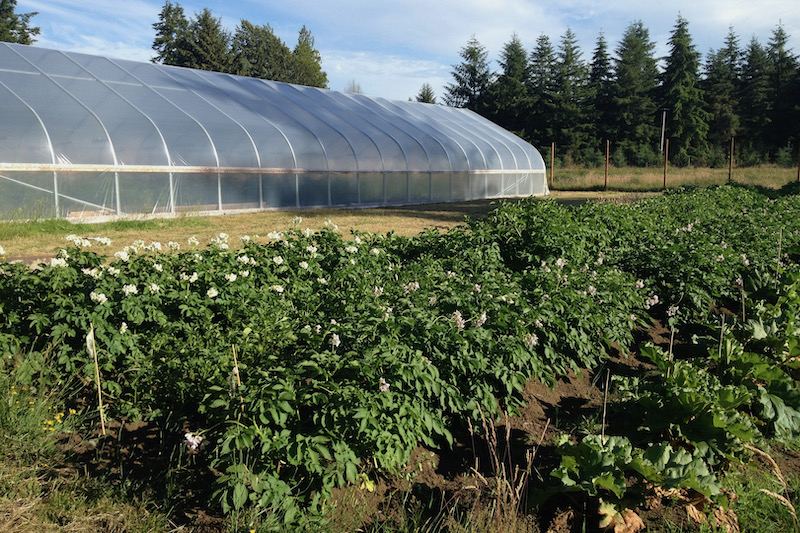
We also ‘dry farmed’ potatoes in 2014 because I’d read that you could grow potatoes without irrigation. There wasn’t really any information available that I could find anywhere on how exactly to do it, so I just guessed about spacing and gave it a go. It worked fairly well for 2014, but 2015 was a drought year, and we didn’t get the potatoes planted on time, or hilled up enough to conserve adequate soil moisture, and the harvest that year wasn’t great. Mostly the area outside the high tunnel grew weeds. It was very, very discouraging.
In the winter of 2015 I attended Oregon State University’s Small Farms Conference. I had a conversation there with Lauren Gwin, one of the directors of the Center for Small Farms, and told her of our irrigation project woes. At the conference, Lauren introduced me to Amy Garrett, a Small Farms Extension agent who had begun researching dry farming as a response to drought pressures in the Willamette Valley. Dry farming is the practice of growing crops without additional irrigation water, relying on the moisture held in the soil after winter rains to provide plants with what they need. It’s nothing new, humans have grown food this way since humans first started cultivating plants for food. But it wasn’t widely practiced in the Pacific Northwest in 2015. Amy was looking to start some on-farm research trials in 2016 that would involve farmers from around the state of Oregon dry farming crops using certain varieties, planting methods, and cultivation practices, and sharing our results to begin to better understand how we might adapt dry farming methods to our growing region. For more information about dry farming, you should check out the Dry Farming Institute, the organization that Amy went on to found after she left OSU.
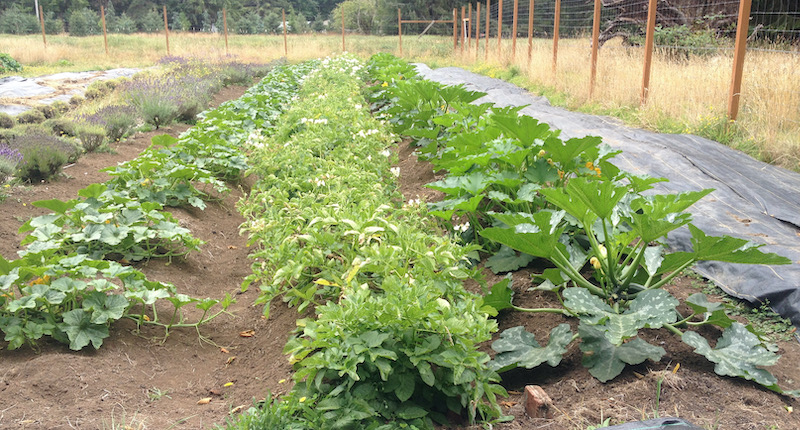
I volunteered our farm immediately as a participant in the Dry Farming Collaborative, and my journey into the world of dry farming began during the growing season of 2016. We selected three crops from Amy’s list to trial here: Dark Star zucchini, Zeppelin delicata, and Yellow Finn potatoes. There wasn’t much guidance given about bed size or spacing between plants, just rough estimates. I remember in June preparing the beds with interest but honestly not really believing that it would actually work, especially for the squash plants. I’d always read that squash plants needed a lot of water to grow successfully, so on planting day in early June I tucked each of the squash plants into its hole, gave each a drink of water, and walked away assuming that if I was lucky only some of the plants would die. I was a little more confident about the potatoes, but we were still experiencing low rainfall that year, and I worried about another marginal harvest.
A few weeks after the dry farmed crops were planted, my knee blew out, my father died, and my whole world went sideways. It would be sometime in late August before I would be able to walk all the way down to the lower farm again, so I relied on our farmhand Kai to keep things going down there, and to update me on the dry farmed crops. Not only did none of the plants die, the first time he brought up the zucchini harvest I was blown away not just by the volume, but by the quality of the squash. It was gorgeous, delicious, and abundant. It continued to be productive until late September when the nights got too cold and the plants were consumed by the inevitable powdery mildew we get here on the Oregon coast. I vowed never to grow irrigated zucchini again, and I never have.
The potato and the delicata squash also did pretty well, well enough for me to say yes to further dry farm crop trials on our farm. The winter of 2017 I attended the first group meeting of the Dry Farming Collaborative, and over the next few years our farm would participate in a number of different research projects focused on dry farming different crops and varieties proposed by researchers at OSU. I learned so much about our soil, about how different dry farming is on the coast from dry farming in the Willamette Valley. We trialed lots of different winter squash, tomato, potato, and dry bean varieties over the years.
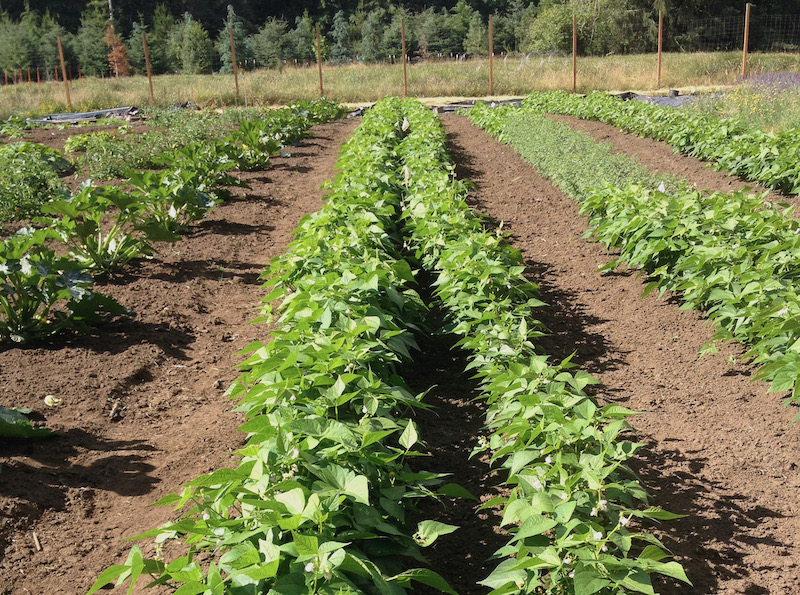
I credit the Dry Farming Collaborative to introducing me to the idea of growing dry beans on our farm, something that I would not have considered possible in our coastal climate. Dry beans have now become one of our favorite crops, and our beans sell out every year. Through these research trials I was introduced to some of my favorite varieties that I now cannot imagine not growing: Lower Salmon River, Stella Blue, and Zeppelin Delicata winter squash, Dark Star zucchini, Whipple beans, and Belmonda potatoes.
During the 2018 season researchers had come and installed soil moisture sensors at varying depths in the soil to better understand how quickly our soil dried out during the summer, and had also taken a 5′ soil core sample to get a better idea of our deeper soil profile. I learned through taking weekly moisture sensor readings that the soil in our lower farm held on to water really, really well due to the layer of clay that lived about 2.5 feet underneath the gorgeous silt loam soil layer, a feature discovered through the soil core sample.That year I greatly reduced watering the cherry tomato crop in our high tunnel in the lower farm, and in future years we only ever watered the high tunnel tomatoes twice in the growing season–once at planting, and maybe once when flowers set. Even inside the high tunnel the tomatoes were able to access enough water deep down that the plants still topped 10′ or more, and the tomatoes were abundant and delicious, and far less prone to splitting than irrigated ones.

Dry farming completely changed how I irrigate our farm, greatly reducing our use of water overall as I came to better understand how moisture moves through our soil in both growing areas on the farm. I grow determinate tomatoes outside in our upper farm now, and although they are growing among rows that are being irrigated and I can’t call them officially dry farmed, we don’t irrigate the tomatoes after they are first planted and watered in once. They do great each year, producing generous yields of gorgeous delicious tomatoes.

Reduced irrigation water in the summer means more water is left in the watersheds that our municipal water system pulls from, and on the Oregon coast, all river and creek based water systems are pulling water out of salmon habitat, where it is crucial to have adequate water in the systems in the summer months to support juvenile fish in their first year of life. Reduced irrigation on our farm also means less time putting out and taking up irrigation drip tape, and thus less of this useful, but sadly plastic material ends up in the landfill at the end of its life. Less money is spent on buying new plastic parts to replace the parts that inevitably break, and that’s a benefit to our farm too.

Ironically, in 2016 we ended up gaining the ability to irrigate the lower farm after all. 2016 was the first year that it was legal in Oregon to grow medicinal marijuana commercially. We were approached by some local folks who were looking for land in Clatsop County to try it out, and we had over half an acre of fenced land growing weeds that might as well grow actual weed instead. We leased them about a quarter of an acre, warning them that they would have to irrigate it with the water tank on a trailer plus generator-pump set up. I think they maybe did that twice (it wasn’t a huge water tank, and weed plants are thirsty), before they showed up with an enormous roll of black plastic tubing and figured out a pretty janky but workable way to connect it to our upper farm water source, run the tubing down through the pasture, across the gully (that involved some fun logistics) and into the lower farm area.
It wasn’t an ideal set up–connections in the line would pop apart somewhere in the middle of the pasture and we’d be dumping gallons of water (that we were paying for) onto the wetland before we could find the break and re-connect things. Packy mowed over the black tubing more than once, making for more repairs. Sometime in 2019 the tubing was buried, although there is still the crazy exposed bit going across the gully, and it all still feels pretty temporary and likely to break down at some point in the future. It’s one of those projects that we know we need to revisit and fix at some point, but for now it works well enough and isn’t shouting at us, so we leave it be. We actually irrigate very little of the lower farm beyond the high tunnel, most years maybe just one or two rows outside, and even then the crops are mostly just watered to help them get established, and then irrigated very little after that. Most of the land in that field is dry farmed, and I can’t imagine growing crops any other way there.

As our dry farming trials progressed each year, and I learned more about what to grow and how to grow it, both crop yield and quality got better. I gradually expanded our dry farmed beds and crops until by 2025 most of the lower farm was under cultivation, most of it dry farmed. In 2025 I ran a dry farmed cover crop trial with our local OSU Extension service which was helpful and informative. We have plans to incorporate summer cover crops into our bed rotations now to help mitigate for the challenges of getting winter cover crops sown in time due to the short window available between harvest and first frost.
The fall of 2016 brought other disasters to this country, the results of which are still deeply affecting us today. Although I miss my dad deeply, I’m glad he passed away before election night of 2016–the results of that and the subsequent years of growing divisiveness in America would have broken his heart. It’s crazy how much the world can change in ten years.
I’ve learned a lot in this last decade through some hard lessons, both personal and professional. I sometimes wish I could go back and talk to 2016 me and offer up words of advice, warning, comfort, and support, but the challenges of the past have all led me to where I am today, and that’s a pretty good place to be. The decade since 2016 has also been full of discovery, success, joy, new friendships, and an growing and enduring love for this community that we are so fortunate to be part of and to be farming for. It can sometimes be hard to see a clear path forwards these days, but I know it’s there, and I’m just going to keep walking forward and discover it as we go, knowing that with the support of community, friends, and family, and a willingness to believe in possibilities, we can accomplish more that we often let ourselves imagine.
