

Beans: fruit or vegetable? Technically beans are a fruit, because they carry their seeds on the inside of their skin. (It’s more involved than that, but that’s basically the gist of it.) Perhaps it’s because beans are mostly eaten in savory recipes that they are usually grouped with vegetables, along side other ‘fruits’ like tomatoes and squash–both of which go really well with beans by the way. Sometimes beans are given their own group called ‘Legumes’, and the thing you need to know here is that all beans are legumes, but not all legumes are beans. Some legumes are peas, or peanuts, or lentils.
Beans are one of the oldest cultivated crops on the planet–humans have known the benefits of eating these protein packed seeds for thousands of years. Most of the beans that we are familiar with today are Phaseolus vulgaris, or common beans, and Phaseolus coccineus, known as runner beans. Both originate in the Americas and have traveled far and wide, adapting to grow all over the planet. There are so many sizes, shapes and colors of beans, with just as many colorful origin stories. Dried beans can keep for years and still germinate. They slip easily into a pocket and can be sewn into clothing, meaning that they could travel great distances and be planted far from where they were first grown, allowing both willing immigrants and forcibly displaced peoples to carry familiar foods with them to new homelands. European colonizers introduced both Phaseolus vulgaris and coccineus from the Americas to Europe where varieties were shared, adapted, and grown on to become so deeply rooted in cultures like Italy and Greece that bean varieties like borlotti–which originated in Colombia and was known as cargamanto there–are now deeply associated with the cuisines of Portugal, Italy, Greece and Turkey and are considered traditional there. (Much like tomatoes, corn, potatoes, and peppers, all plants unknown to Europe before the colonization of the Americas began in the 1500s.)
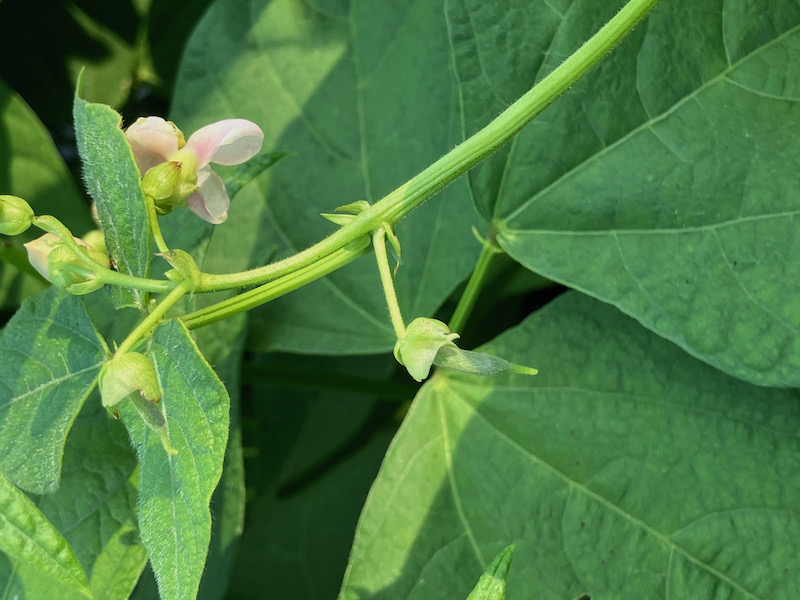
I’ve loved growing beans since we first began farming in 2004, focusing first on fresh green beans, both pole and bush. There are abundant newer varieties bred for the fresh bean market, and many of them are productive, uniform, and taste fine, but I found myself being drawn to heirloom varieties that I discovered through organizations like Seed Savers Exchange. I was especially liked growing beans that served a dual purpose–meaning that they were a good fresh green bean, but if harvest got away from me and the beans matured too much to be good as a fresh green bean they could be grown on for seed and used either as a fresh shelling bean (sometimes called shelly beans) or as a dry soup bean. Varieties like Rattlesnake, Lazy Housewife, and Cherokee Trail of Tears all had stories to tell which made them even more meaningful for me to grow.
Up until 2017 all of the beans we grew were irrigated. I didn’t know that you could dry farm a bean, but when I got involved in the OSU Small Farms Dry Farming Collaborative, participating in on-farm research trials to better understand and support dry farming in Oregon, I found myself signing up for a dry bean variety trial even though I had always believed that dry beans would be too risky to grow to maturity in our north Oregon coastal climate. For dry beans, you have to let the plants fully mature their seeds before harvest. The seed pods need to stay dry up until harvest, and sometimes the timing of that can be tricky with our fall rains. Dry farming–where no irrigation water is applied to crops, and they grow just using the available moisture stored in the soil–can be a challenging environment for crops to thrive in, and although some varieties adapt well and offer decent yields grown in dry farmed conditions, some struggle to produce decent seed in more arid conditions. One positive thing I’ve found is that dry farmed beans dry down faster and drop their leaves earlier, making harvesting the seed pods much easier.

Over the years I’ve found a solid group of bean varieties that consistently grow well for us. I’m always open to trialing new ones to see if I can expand our bean offerings because there are thousands of beans out there, and I am so drawn to their beauty, flavor, and stories. This year I tried dry farming some of our pole beans, starting with the three runner bean varieties we grow and one variety that might be a borlotti type, and I think there is some possibility there for adaptation to at least a low-water growing system without sacrificing too much yield. The stress of being dry farmed encouraged the pole beans to mature faster and drop their leaves earlier, which was great help as most of them are longer season varieties whose seed pods are only just starting to dry down in late September when our first rains usually start. At this point the farm is pretty much maxed out for what we can grow and get harvested, dried, threshed and winnowed without additional drying space or expensive mechanization. (Every year I am tempted to invest in both so we can grow more beans!)

On my kindergarten playground in Berkeley, California I learned the Bean Song this way:
Beans, beans, the magical fruit.
The more you eat, the more you toot.
The more you toot, the better you feel.
So eat your beans with every meal!
I’ve seen it start with ‘musical fruit’ as well, which makes more sense really, given what we’re singing about. Did you learn this song as a child? What version did you learn?
The thing with beans causing flatulence when you eat them is a real thing, and sadly a reason why some folks avoid them. This is due to the high fiber and complex sugars that beans contain, both of which can be hard for us to digest, but the high fiber in beans is tremendously good for us as well! So please don’t avoid them. It’s important to note that gas is a normal bodily function, part of the digestive process. Some studies show that soaking the beans and discarding the water several times can help reduce gas, as the soaking releases some of the gas-producing compounds. Not all of them though. You can add herbs to your beans like epazote, which is used in Mexican cooking as both flavor and as a digestive aid. But the thing that studies show helps the most is to eat more beans! Yep, gradually increasing your bean intake by around 1/2 cup daily has been show to reduce bloating and gas after about an 8-week period. It’s thought that your gut microbiome adjusts to the influx of the complex fibers in the beans and gradually adjusts to them, reducing the side effects.
So perhaps the song should go: The more you eat, the less you toot!
Beans are a crop that continue to fascinate me (I didn’t even get into their soil nitrogen-fixing skills!) and I can’t imagine not growing them in some form or another for the rest of my life. It’s been a joy to discover so many dry bean varieties that will produce well here in our cool coastal Oregon climate, and I look forward to discovering many more. Each year when I crack open that first dried pod and see the colorful beans inside I feel a fizz of excitement that it worked again, and that we’ll have lots of delicious beans to share with our community.

Below are the bean varieties we grew in 2025, and plan to grow again in 2026 and beyond. We sell them mostly as dry beans for eating, but have started to package some in seed packs for home gardeners to try growing out for themselves. We don’t ship the beans, you have to come to one of our autumn or winter markets in person to pick some up for yourself. They sell out every year, so get there early if you can.
Whipple

Whipple was one of the bean varieties we grew in our very first dry farmed dry bean trial, and it did so well for us we’ve grown it ever since. Bush plants produce large maroon beans flecked with white that are a delight to shell when dry. We use it mostly for chili and soup, where its slightly larger size and meaty texture really shine. It’s delicious! It’s also one of the most productive varieties we grow, always giving a decent yield even in drought years. Considered a Pacific Northwest heirloom variety from the Willamette Valley, Whipple is named for the Lee and Dana Whipple, who moved from Chicago (where Mr. Whipple, a minister, had marched with Martin Luther King Jr.) to Oregon to homestead. Known for being a good bean for dry conditions, Whipple is one of the bean varieties recommended by the Dry Farming Institute for growing in dry farmed conditions.
Rockwell

Another Pacific Northwest heirloom variety, Rockwell is a favorite for us because it germinates well in cooler conditions (always an issue for coastal farms in Oregon) and it’s adapted well to grow in dry farmed conditions. Considered a ‘cassoulet’ type bean, they are excellent in just about any recipe, holding their shape well when cooked and absorbing flavor beautifully. It was introduced to Whidbey Island in Washington by Elsa Rockwell in the 1800s, and for years was stewarded there by small farmers in the Ebey’s Prairie area. Rockwell has begun to travel more widely now, and along with being recommended as a good dry farming variety by the Dry Farming Institute it was recently introduced into the Slow Food Ark of Taste. Yield for us can sometimes vary depending upon the growing year, but it’s always decent and well worth growing. If left to dry too long in the field the seed pods are prone to popping early so you’ve got to keep an eye on it and get it harvested before that happens. Once harvested and laying out to fully dry in our propagation house, we’ve learned to cover the drying pods with a long piece of row cover fabric as we’ve found the pods have a tendency to explode and spread their seeds all over on hot days.
Beers

I found Beers beans through Adaptive Seeds, a wonderful seed company based in Sweet Home, Oregon. When I read their description: “Who would have thought that there was an Oregon Coast heirloom dry bean?! We thought it must be good because growing dry beans along the cool, damp Oregon coast is not easy” I knew that Beers was a variety that I had to try, and it has not disappointed us at all. Beers adapted well to our dry farming conditions, and produces good yields for us each year with very few off-types or damaged seeds. Named for Charles and Priscilla Beers, who brought the bean to the Oregon Coast from Nebraska in 1895, Adaptive Seeds first got the variety at a seed swap from a lady growing it in Lincoln City. The pale tan beans are creamy and flavorful when cooked, holding their shape in soups and stews. They also make an excellent refried bean or bean dip. I often use them when a recipe calls for cannellini beans, finding them similar enough to work just fine there.
Washington Black Beans

Seed breeders and growers are a very particular kind of person, often very focused and slightly intense. The kind of person with the patience to spend years observing plants, selecting seed, sometimes cross-pollinating for specific characteristics, growing out plants again, observing, selecting, and so on for years and years and years. Wonderful, dedicated folks that all people who grow plants should be grateful to for the diversity and beauty that they make available through the wonderful plant varieties they steward, save, and share. I once had a very long conversation with a fascinating seed breeder named Chris Homanics who I met through the Dry Farming Collaborative, I think while working on a potato variety trial. I had mentioned to him that I really loved black beans, but that the traditional Black Turtle Bean (widely used in South and Central American cuisine) needed too long a growing season for my Oregon coastal farm. “I’ve got just the black bean for you!” he enthused, telling me that there was this variety of bush black bean that some PNW growers had been having some success with, and that he had some seed for it that he was willing to share with me. A few weeks later a box arrived at the farm with not only a huge bag of black beans simply labelled “WA Black Bean’ but a wide variety of other seeds for me to try. This black bean is one of the later varieties to ripen for me, but each year I select out the earliest and best seed pods to save seed from, and each year I think it produces a little bit better for me. So now I’ve got a black bean I can grow on the Oregon coast. Thanks Chris!
Wally

Wally beans are very special to me as they are one of those true ‘passed down from a friend of a friend with a story’ varieties and not one that I first purchased through a seed company. I wish I knew more about it, but here is what I do know: my dear friend Jane Donnelly knew I liked growing beans on the farm, and one year she asked me if I’d be interested in growing out a variety that a friend of hers was growing. It had been passed to Jane’s friend from an older gentleman named Wally who lived in her neighborhood in Seattle. Wally had gotten the bean from his mother who had brought it to the US from Italy. Jane handed me a small envelope containing some of the most beautiful bean seeds I’d ever seen-pale brown with darker brown swirly markings on them. We grew them out that year, and they were lush, tall vines full of medium sized flattish Romano-style bean pods that when mature produced an abundance of beans. What’s funny is that I cooked them and found them to be absolutely delicious-meaty and flavorful, gorgeous in soups, stews and some simple long braising recipes, and I only found out a couple of years later that Wally actually grew them for the fresh green bean, not the dry bean seed. I’m still trying to figure out what bean this could be. I found a close image match on the Victory Seed Company site called ‘Valena’ which was passed down through their family from Emilio Valena of Sonoma County, California, who brought the bean with him from the Lombardy region of Italy. They describe the bean as a ‘horticultural bean’, meaning that it can be eaten fresh when young as a green bean, or grown to maturity as a dry bean. The pictures look just like Wally’s beans, but they have been out of stock forever and I can’t buy some to grow out and compare. They also look very similar to Kahnawake Mohawk Beans, an heirloom variety of the Iroquois First Nations of Kahnawake, Quebec, a variety I only stumbled across this year when I was looking for information about another heirloom bean we grow. I plan to get some Kahnawake Mohawk beans and grow them out in our 2026 season to compare them, and see if they are indeed family to Wally’s bean. I find it fascinating that there are two stories of the bean coming to the US from Italy, but since this bean is not native to Italy and it had to get there from the Americas, it seems reasonable that they may have originally come from the Iroquois Nation near Quebec. Whatever they are called, I plan to grow them for the rest of my farming life, and enjoy them for their beauty and delicious flavor, and feel happy about our farm’s role in continuing to share this wonderful bean with a wider community.
Mostoller Wild Goose
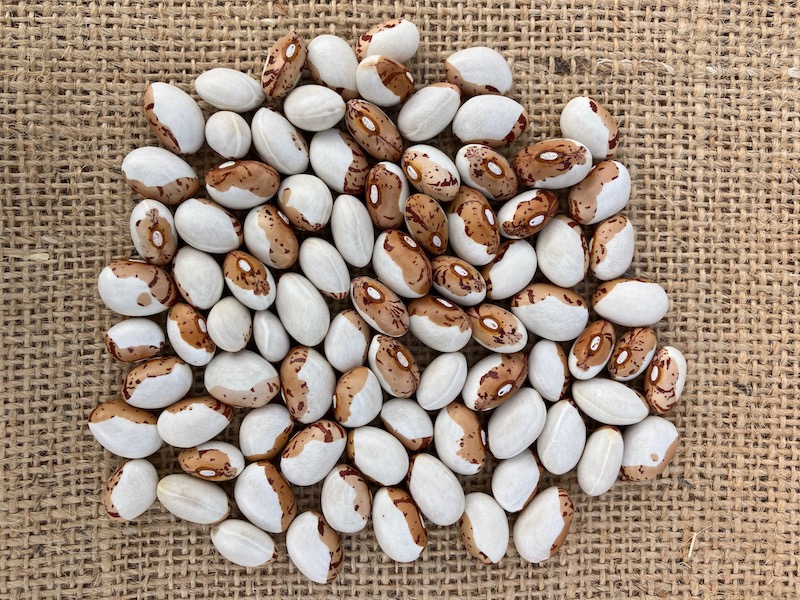
I was handed a small, hand-labeled packet of these beans one year from an Astoria gardener named Fred White. I’m not sure if it was the story or the beauty of the bean that first caught me, but I loved both and I’ve loved growing this lovely pole bean for years now. The story goes that in 1865 Sarah Mostoller discovered the beans in the in the crop of a wild goose that her sons, John and David, had shot in Somerset County, PA. The beans were planted the following spring and grown by subsequent generations of the family. The bean was donated to Seed Savers Exchange in 1981 by John Withee, who received it from Ralph V. Mostoller of Johnstown, PA, great grandson of Sarah Mostoller. More than just beautiful, this is a wonderful all-purpose bean. I love to use it in any soup or stew recipe, or do a simple slow cooker braising with some garlic and herbs and then use it in pasta dishes or salads. This is the earliest maturing pole bean variety we grow, which makes it even more appealing to this Oregon coast farmer.
Lazy Housewife

I don’t love the name of this bean at all, as most ‘housewives’ that I’ve known are some of the hardest working people around. But I do love this bean! I bought my first packet of Lazy Housewife probably back in 2014 or so, and I don’t remember who I bought it from. At the time I was very drawn to multi-purpose beans that were good both as fresh green beans and as dry beans. Lazy Housewife was introduced in 1855 by W. Atlee Burpee and Company, who described it in glowing terms: “the pods are green, entirely stringless, of extra fine flavor, exceedingly rich and buttery when cooked”. The seeds are like lovely large pearls, round and white. I think Burpee was talking about the fresh beans in their description, but I find the seeds to be quite rich as well, creamy and flavorful, holding their shape when cooked and working well anywhere a white bean is called for. I don’t harvest any of the beans for fresh eating anymore because I want as much of the seed as I can get, but it’s versatility is still appreciated.
Scarlet Runner Bean

This bean is such a beauty! Vigorous vines grow well over 8′ tall and are covered with lovely red flowers that attract bees and hummingbirds in equal measure. The flowers are followed by large flat seed pods which mature to produce some of the most gorgeous seeds, often deep black speckled with lavender. Runner beans originated in the highlands of Central America, probably first cultivated in 2000 BC in what is now Mexico and Guatemala. Like its common bean relatives, it traveled to Europe and Asia after colonization in the 1500s, and have become so much a part of many cultures that they are considered heirlooms in many countries. Red flowered vines produce the black speckled seeds, and white flowered vines (see below, Modovanesti Buffalo and Giante) produce white beans. In Great Britain the green beans are prized, harvested young when they are tender and cooked lightly or pickled. I love adding Scarlet Runner Beans to soups and chili, the beans swell to enormous size and add lovely texture, flavor, and color.
Moldovanesti Buffalo
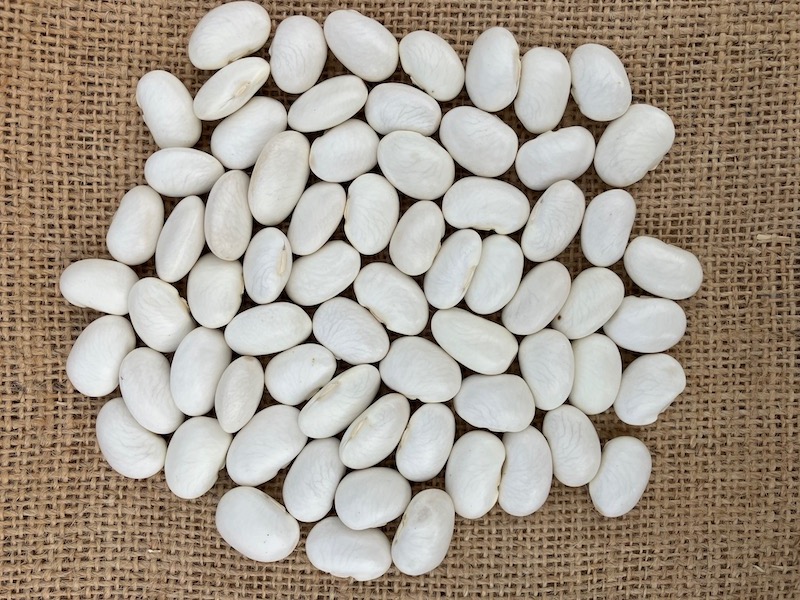
I was first drawn to growing Moldovanesti Buffalo beans because I was really looking for Greek Gigante beans, but couldn’t find them. These are an introduction to the US from Adaptive Seeds, who collected the variety on a trip to Moldovanesti in the Transylvania region of Romania, where water buffalo are still used as draft animals for cultivation. White runner beans are also called butter beans in England, which can be confusing as in America butter beans refers to lima beans (Phaesoleus lunatus), while white runner beans are sometimes called potato beans. Regardless of what you call them, Moldovanesti Buffalo has won a place in my heart and on our farm as they are productive and delicious, not as huge as Scarlet Runner or Gigante beans, but just wonderful, delicious, tender, amazing.
A side note about lima beans. I haven’t grown them on our farm because everything that I’ve read about lima beans indicates that they don’t grow well in cooler growing climates, and I can’t be bothered with plants that need a lot of hand holding in our coastal Oregon environment. I’m pretty sure it has nothing to do with memories of me at six years old sitting at the dinner table long after everyone else had been excused, a plate of lima beans in front of me, a bottle of ketchup next to my plate to add flavor if needed, with my mother’s admonishment that I needed to try ‘just a few bites’ before I could leave the table. Pretty sure it’s not that.
Gigante

When I was at University I had a Greek boyfriend named George who was slightly crazy, but an excellent cook. In addition to the miracle of a slow-cooked leg of lamb, a simple salata horiatiki, homemade dolmades, and the dangerous beverage ouzo, he introduced me to Gigantes Plaki- Greek baked beans that use these enormous white beans slow cooked in a savory tomato sauce. It’s an phenomenal bean dish, and it haunted me for years (longer even than I was haunted by George after we parted) because I just couldn’t find the beans anywhere in the US, and even large white beans like cannelini just won’t do for this. I had friends pick up some Gigantes beans for me when they were traveling in Greece back in 2013, but that’s a sketchy long-term supply plan. Fortunately the world has become much smaller in recent years, and you can find packages of Gigantes beans on the internet now. A couple of years ago I bought a pound, cooked most of them up but saved about 30 seeds to plant just to see how they would do here, because the Oregon coast has a slightly different climate to Greece. The results so far are mixed–they grow well, produce huge vines covered in pale blush flowers and are loaded with long, thick green beans. The tricky bit is getting them to ripen to maturity–they seem to really want a much longer, dryer growing season than what I can offer them. I’m not giving up, as I’m getting enough ripe seeds each year to make it worth it to me, and I’ll keep selecting for the earliest ripening seeds as much as I can. In Greece these beans are known as Gigantes Elephantes, or Giant Elephant beans, and have PDO (Protected Designation of Origin) from the European Union. Only beans grown in the Kastoria region of Greece can be called Gigantes Elephantes, everywhere else they are grown they are just Gigante. My Oregon coast Gigantes are wonderful and delicious, and are some of the first we sell out of each year.
Speckled Housewife and Other Off-types

Beans are pretty good at coming true from seed without too much cross pollination, but with bees moving pollen around from plant to plant, a bit of genetic mixing and matching is bound to happen. In every bean harvest there is a certain percentage of ‘off-types’–beans that are slightly different from the parent plant. Sometimes it’s a different color or shape, and sometimes I can trace back where some of the variation probably came from. I’ve found that Lazy Housewife is most prone to genetic persuasion, and every year among the true-to-type white pearl-like seeds (lower right in image above), there are pods that open to reveal all manner or colors. Still mostly round-ish, they might be multi colored with speckles, or a solid deep red, or a blueish black. Some came out pale greyish blue with the markings of Wally beans which had been growing nearby. I love these off-types, and have begun saving them and growing out the speckled ones to see what comes out the following year. Most of our off-types end up in our Soup Bean Mix, but some of them are so charming I just have to see if I can get them to come back again.
